Why Generic Schemas Break Text Models

TLDR Generic text annotation trains your model on someone else’s product logic. At posterior.xyz we annotate to the taxonomy you define, keep tone intact across languages, enforce transcription rules you can audit, and version every judgment call so labels stay stable as your data grows.
Why do generic labels train the wrong behavior?
A schema that almost matches your product still teaches the wrong boundaries. Entity spans drift. Sentiment means something slightly different from what your support team means. Intent labels blur.
That drift compounds. Eval scores look fine while users hit the gaps. The fix is plain. You bring definitions and examples, we work from them, and you approve them before production starts. No adapted approximation.
How is annotation done to your schema?
You define the labels that drive decisions. We apply them to prompts you collect, conversational tasks, or content you provide for annotation.
| Task | You set | We deliver |
|---|---|---|
| Named entities | Entity types and span rules | Spans marked to your boundary rules |
| Sentiment and emotion | Definitions tied to your use case | Labels calibrated to those definitions |
| Semantic judgments | Guidelines for intent, topic, similarity, inference | Judgments that follow your guidelines |
| Moderation | Policy-sensitive categories you specify | Careful labeling with reviewer care |
Annotators work from your schema from day one. If a definition changes, the work changes with it.
How is tone kept in translation?
Meaning lives in tone as much as words. We cover English, Hindi, Kannada, Telugu, Tamil, Malayalam, Marathi, and Sanskrit, plus more on request, with native reviewers who preserve intent across adaptations.
You set formality, politeness, and domain terms. Translators flag phrases where a direct rendering would mislead, and you pick the preferred wording. Source and adapted text stay linked, so you can audit how tone carried over and revisit choices later.
This shows up fast in support chats and payment flows, where abruptness or extra formality can change what a user does next. Kinda small on paper, maybe large in production.
Which transcription rules can you audit?
For speech derived text, small transcription choices shape everything downstream. We agree on conventions with you in advance and enforce them across annotators and languages.
- How to write code switching and loanwords in everyday speech
- How to mark fillers, false starts, repetitions, and interruptions
- How to write numerals, dates, addresses, and product terms
- How to handle overlapping or unclear speech in channel separated and field recordings
Every transcript follows the same version you approved. Quality checks measure against those rules. When you update a convention, we reprocess the affected material so old and new transcripts do not mix.
What happens to ambiguous cases?
Ambiguous cases are inevitable. Unclear boundaries happen. Culturally specific phrasing happens. Two labels can both look right.
Our rule is escalate, do not guess. Annotators send the case up with context. You rule. We document the ruling with examples and the guideline version moves forward. Any label can be traced back to the rule in effect when it was applied.
That version history is the whole game. Training signals stay stable. Eval and error analysis have a clear record to work from. As your data grows across languages and months, judgment stays consistent because the decisions are written down, not remembered.
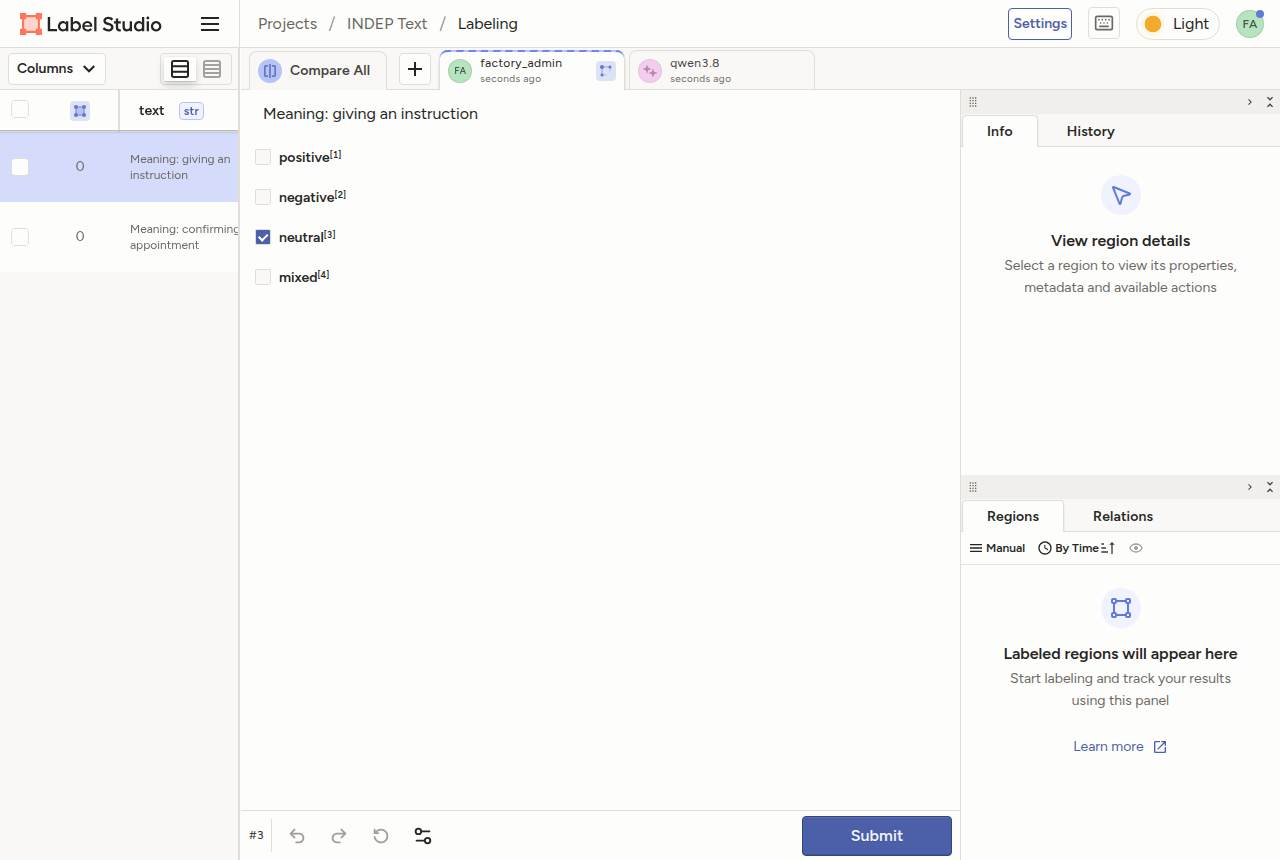
Exhibits from our collection
Raw text as collected, with its source label:
Label: neutral
Reason: The statement is neutral because it reports a fact without strong emotion.
Exhibit 1 — Human judgment to the buyer’s definitions: label plus the reason that ties it to the guideline version in force.
Machine draft with human review required before anything ships:
{"source_file": "04fec456-...e95e.txt",
 "model_output": {"results": [{"model_version": "qwen3.8:latest",
   "value": {"sentiment": "neutral", "emotion": "calm",
    "intensity": "medium", "moderation_decision": "safe"}}]},
 "status": "machine_first_pass", "human_review_required": true}
Exhibit 2 — Draft status is explicit in the record. Nothing ships on a model score; annotators correct every label before review.
FAQ
Do we have to finalize our taxonomy before we start
No. You approve a starting version with definitions and examples. Changes get versioned, documented, and applied going forward, with reprocessing where you ask for it.
Can text annotation feed a multimodal system
Yes. Text labeled to your schema can sit beside audio and video labeled the same way, so entities, intents, and moderation decisions mean the same thing across inputs.
How do we start
Start with a paid pilot. Both sides check fit before scaling. Request a pilot or Talk to us and bring one messy sample set. We will annotate to your rules and show you the guideline diff.
Related reads
Pair with multilingual Indic collection and CVAT and Label Studio in tandem.
Sources
- Label Studio pre-annotations guide — how model drafts arrive as prediction tabs for human correction, exactly as in the exhibit above.
- First-hand: process claims above describe our own pipeline — your schema, tone-preserving translation, versioned ambiguity rulings. The exhibits are verbatim outputs — a real labeling-view screenshot and real draft records — not illustrations.